Laura and I just got back from a long weekend drive to Sheringa in South Australia. The event was Lynette’s 21st birthday celebration, and we have missed so many family events recently that we were determined to get to this one.
Laura has her learner’s licence now, so she drove part of the way which was a great help to me. I have been the sole driver in the family for the past 5 years since Anita gave up her licence due to MS. Since every trip is over 1000km or more, it is a relief to once again be able to share the driving. Laura ended up driving about 1200km out of the 3500km we drove for the weekend. She gained experience in long distance driving, dirt roads, wet roads, night driving, driving in the rain, and driving in built-up areas.
Once we arrived at “Springvilla” and got a good night’s sleep on the Friday night, we went fishing early Saturday morning. It wasn’t the best fishing trip we’ve had but a nice bag of rock cod, sweep, tommies, mullet, and salmon trout made for a very welcome lunch of fresh fish. Much tastier than the frozen fish on offer in Tennant Creek!!
Then it was time for the main event. All of my siblings were there: Sharon, Miriam, Samuel, Michelle, Rachel, Joshua, and Saul, along with their partners and most of their children. Half-brother Leslie was absent, but not missed as I have had no contact with him for years. Mum was there as well, so that made it a full family reunion, something that has not occurred for several years. Everyone is looking older, which is probably not surprising as everyone is older. It hardly seems credible that it is 21 years since I first began visiting Samuel and Sonya at Springvilla, when Lynette was a newborn baby. But here she was celebrating her 21st birthday. Several other nieces are now married, and Miriam is a grandmother. Other nieces are at university. The family is growing up, and the next generation is heading out into the world to make their mark. It is great to see, as I am the first in either side of my family and the only one of my generation to have a Bachelor degree, and now the next generation has several students at uinversity and several more heading that way.
After the party, we rolled out our swags at the venue and stayed the night. Laura and I turned in a little earlier than most because we had 1800km to drive home starting the next morning.
Was it worth driving 3500km just to spend a weekend with family? Absolutely! Laura had some time off work, and I was able to arrange some leave. A bit of overtime work paid for the diesel, so off we went. Anita wasn’t up to such a long drive so she stayed home with Claire and Erin. It would have been nice to include them in the family reunion, but the logistics were too difficult. An advantage of having an almost empty vehicle was that we could pick up Anita’s father Roger to go back to Tennant Creek with us for a month’s visit. If we had all gone to the party, that would not have been possible.
Tropical gardening
It’s interesting growing a garden in Tennant Creek. We gave the wet and dry seasons as we are 500km north of the Tropic of Capricorn. During the dry season, plants need regular watering but the temperature is not high, so it’s manageable. In the much hotter wet season, it is fortunately also wetter, so use of tap water is minimal. Plants grow like crazy though, what with the perfect combination of warmth and water. Hence our front yard looks lush and green at this time of year. Unfortunately we have very little soil in our yard, so growing food plants is difficult. Because of aggressive termites, we can’t use the usual timber planks to make raised garden beds like we did in Oodnadatta. We are currently saving to buy a few Eco posts made of recycled paper, as they are termite proof. They cost about $90 each, do it will be a while yet!!

Report on CRANAplus Conference 2011
Well, I guess it’s about time that I posted something about the 2011 conference in Perth. It was held on October 11-14 and I think it was the best one yet. As CRANAplus has grown, the conference organising has more and more become a staff responsibility, with a subsequent improvement in the quality and feel of the conference. The next step may be to use a conference organiser, but we’ll see how things go with the current setup.
The conference kicked off on the Tuesday evening with a cocktail event, a combination of opening ceremony and presentation of the inaugural Fellows of CRANAplus, as well as the annual presentation of graduates from relevant postgraduate courses in remote health. I was privileged to become a CRANAplus Fellow, as well as being recognised for my recently acquired Master of Remote Health Practice – Nurse Practitioner qualification. So it was two walks to the podium for me!
On Wednesday morning, the conference proper got under way with a keynote address from Professor Colleen Hayward and a smorgamsbord of interersting and informative talks from presenters around Australia. This continued until lunch time on the Friday, with some very special treats on the way. A presenter from the Solomon Islands shared some of his work in the Solomon Islands Red Cross, and a group of Rural Health Club students amazed us with their passion for remote health. The catering along the way was superb, and facilitated many opportunities to chat with colleagues. One of the highlights of the CRANAplus conferences is the chance to catch us with old friends, and make new ones. This time was no exception, as I saw people who I hadn’t caught up with since last year’s conference, and added a lot of new people to my list of contacts.
My own presentation entitled “Dealing with uncertainty in remote and isolated practice” was on Friday morning, and was well received. I have been asked by a number of people if they could use it in presentations of their own, and also if I could present it in other settings in the NT. No worries, I’m happy to share what I’ve learned, and if it helps others, so much the better!
Next year, the 30th CRANAplus Conference will be held in Cairns, and I can hardly wait.
The Nanny State
I used to think government handouts were a good idea. After all, we pay taxes so the government can do the job of running the country, and it’s nice to get some money back. When I was a farmer in the late 1980s, it was useful to get subsidies to help with drought, bushfires and other natural disasters. Subsidies help people recover from difficult situations, or to cope with changes in their lives.
So why do I now believe that government handouts are generally a bad thing? Let’s apply a common household situation. Say the dishes need washing, or the bedroom tidying. The children are reluctant to do the jobs, and put off complying with parental requests, or their own consciences. Eventually, a parent does the dishes or tidies the bedroom. The child learns that he or she does not have to expend the effort to do these tasks as long as they can rely on someone else to do them. It is the same with government handouts. Why put aside money to cope with a drought year or two, or plan for dealing with a bushfire, when you can simply expect the government to pay you when things go wrong. Or why bother trying to find work when Centrelink will pay you not to work? As long as you are satisfied with the standard of living provided by welfare, why allow yourself to be tied to the routine and discipline of a paying job? Sure there is a requirement to actively seek work, but in reality if you live in a remote community, you are exempt from the ‘looking for work’ test, even if there are jobs going begging.
My personal experience of this was in a remote community where for years I tried to hire people to help my wife with the housework. As her MS progressed, it became more and more difficult for her to cope, and I was far too busy at work to spend much time on housework. Despite very high levels of unemployment in the community, during a four-year period we hired a local to help us for exactly zero days. And it wasn’t due to lack of trying! It seemed that it was a source of ‘shame’ to clean someone’s house, yet there was nothing shameful about sitting back and claiming unemployment benefits while a disabled woman struggled for lack of help.
Anyway let’s get back on track before I get completely lost.
My current thinking is that government subsidies stifle individual and corporate responsibility. A farmer who can rely on a handout in drought years is relieved of the responsibiltiy to plan for drought years despite the fact that they are an inevitable part of farming life in many parts of Australia. A company which relies on government tariffs on cheaper, better imports is relieved of the burden of making competitive products, and hence has less incentive to invest in quality – look at Australian-built cars for example, nearly as bad as American-built cars, and for the same reason. A mother who can rely on the welfare system, and the generosity of strangers, to feed her children has little incentive to divert resources away from feeding her own smoking, drinking, or obesity.
I do believe that government has a role to play in providing a safety net, but I think the balance has swung so far in that direction that it’s now more than a safety net, it’s a lifestyle. If people can live on welfare, then welfare is too generous. Everyone has a right to adequate food, water and shelter. Beyond that, everything else must be earned. Companies don’t have the right to any support, as they are supposed to risk-manage their business rather than expect governments to bail them out when they screw up.
One final example that shows how subsidies don’t work:
In 2006, the Australian Government introduced a $2000 rebate for conversions of petrol or diesel vehicles to run on cleaner-burning LPG. Immediately prior to the rebate, a basic conversion for a Falcon station wagon cost around $1600 to $1800. By mid-2007, a basic conversion for the same vehicle cost around $3500. This was despite a huge increase in the number of conversions occuring and the number on installers competing for market share. Therefore, the actual cost to the consumer reduced from an average $1700 to an average $1500, while the rest of the subsidy ($1800) became profit for the installers. As the amount of the rebate has fallen over the subsequent years (to currently $1250) the average cost of an installation has also fallen so that the actual cost to the consumer is still at around $1700. It seems that the market value of an LPG conversion is $1700, and all that subsidies achieve is to inflate the price so the consumer still pays the market price.
CRANAplus Conference 2011
This year, the CRANAplus annual conference will be held in Perth. I submitted a paper “Dealing with uncertainty in clinical practice” which was held in reserve as the organizing committee had more papers than they needed. This was a good thing, as it wasn’t too long ago that CRANAplus struggled to get enough papers to fill the slots at the conference. I have written and presented papers at the past four conferences, so it was with some relief that I found I could have a rest this year. Or that was the plan.
Last week I was emailed a request to consider presenting after all. It seems another speaker had pulled out. It didn’t take more than a few seconds to decide that I felt strongly enough about my topic to go ahead, so it’s back on track. Watch this space, as I jot down some thoughts about the topic, to add to what I’ve already posted.
Hiking on Fraser Island – Day 5
Day 5
Our last day on the island dawned clear and cool. We got up early as this was to be the longest walk of the hike, about 24km with our packs. The planned route took us from Central Station to Basin Lake, then Lake MacKenzie, then along an old tramway to the remains of MacKenzie’s Jetty. From there we could choose whether to walk along the beach or along the forest trail to Kingfisher Bay. Our booking was for 5:00pm on the ferry, so we had a deadline to meet.
Breakfast consisted of the last of our oatmeal sachets and condensed milk tube, washed down with hot Milo. By this time, we were getting low on food, but there was enough to allow us morning tea and lunch. Afternoon tea would have to wait until we got to Kingfisher Bay, so there was an added incentive to keep going. If we arrived early enough, we could have a proper afternoon tea at the resort! The tents and sleeping bags were rolled up for the last time this trip, the water bottles topped up and sterilised, and we were on our way just before 7:30am.
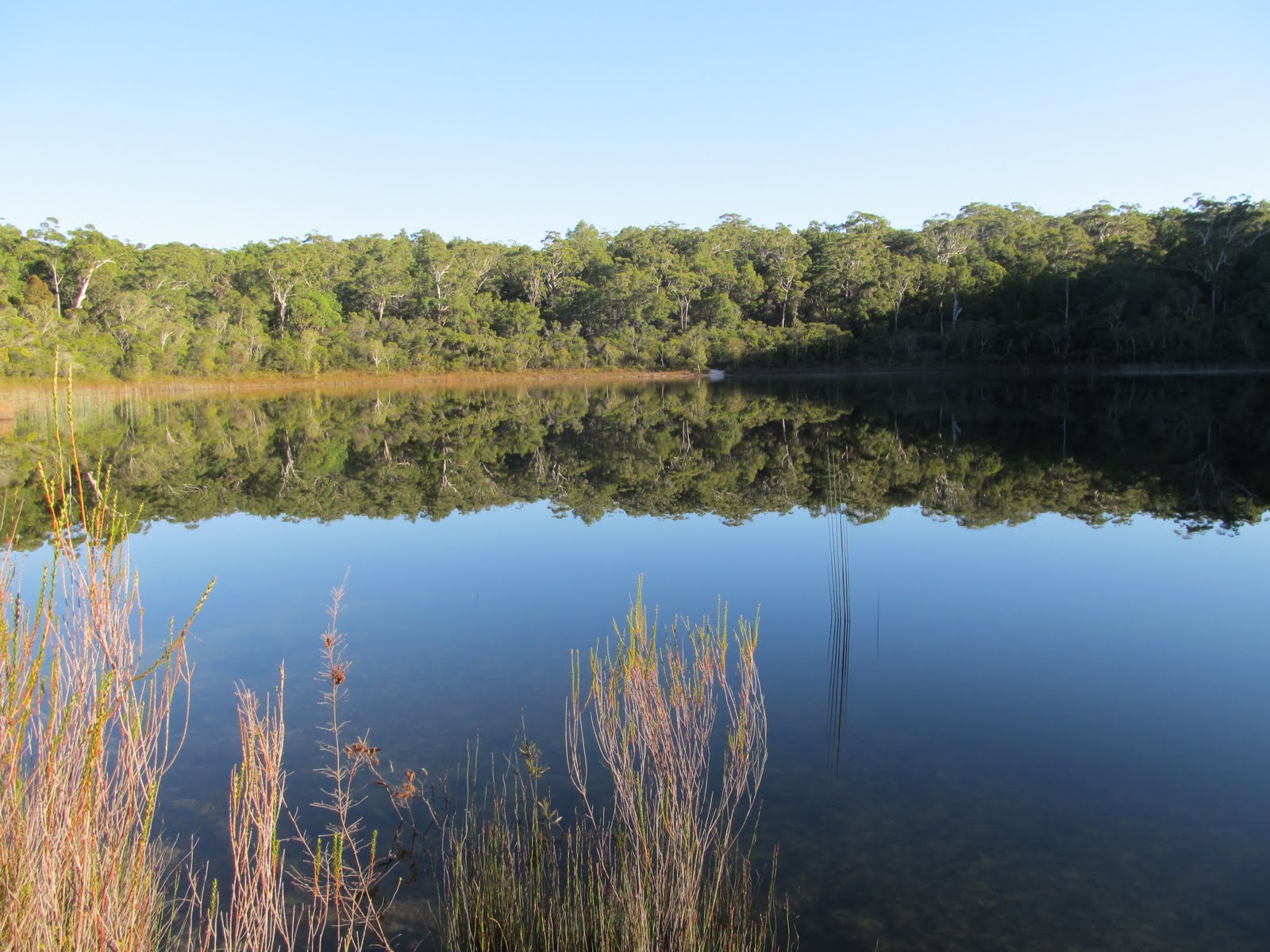
The first part of the walk took us via Wanggoolba Creek, a crystal clear creek that flows past the Central Station campground. There were various relics of the timber logging days, such as a derelict loading ramp, a glass-topped petrol bowser, an an old engine block. From Wanggoolba Creek, we ascended a long ridge until we arrived at a breathtaking scene – Basin Lake in the morning sun without a ripple on its surface. There was no-one else there, so it was peaceful. We could easily have spent an hour soaking in the beauty of the place, but the remaining 21km of our hike and the ferry deadline spurred us on.
 |
||||
| Basin Lake |
Lake MacKenzie was only a short walk from Basin Lake, about 35 minutes. This was where we began to see other people by the busload. Lake MacKenzie has pure white sand and clear blue water, and amazingly looks exactly like on the postcards of Fraser Island. In fact, I’d say it looks even more beautiful in reality than it does on a postcard or in a photo. We had planned to spend some time there, but the water proved to be more chilly than expected. A photo taken by a helpful tourist was enough, before we gladly exited the water and donned our boots again to continue the hike. After morning tea of course! It is important to get the priorities right. Morning tea consisted of our last packets of 2-minute noodles, and some left-over muesli bars.
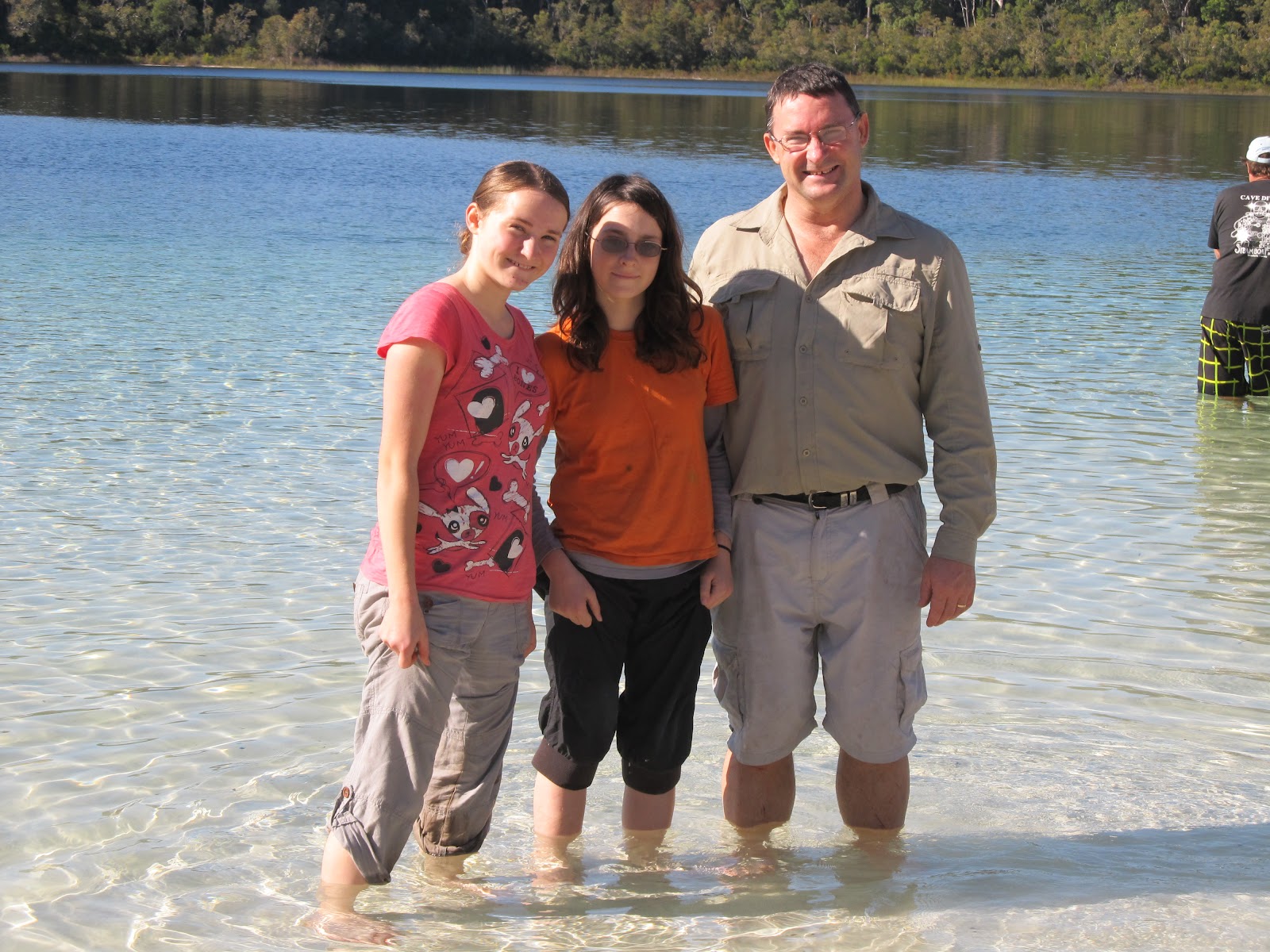 |
| Laura, Claire & John at Lake MacKenzie |
Our hiking map showed that the trail followed around the western and northern shores of Lake MacKenzie, before heading due east for a couple of kilometres. Only when it met up with the trail to Lake Wabby did it veer back towards the west and MacKenzie’s Jetty. On the other hand, a vehicle track cut due north from Lake MacKenzie, only requiring a 500m detour to the south-east to connect with it. This track ended up joining with the walking trail we wanted to be on, and saved over 3km of walking. All we had to do was miss seeing the sign that said “No Pedestrian Traffic” and we were on our way. At one point we had to scramble off the track as a huge 4WD tour coach took up the whole track, but otherwise we had it to ourselves.
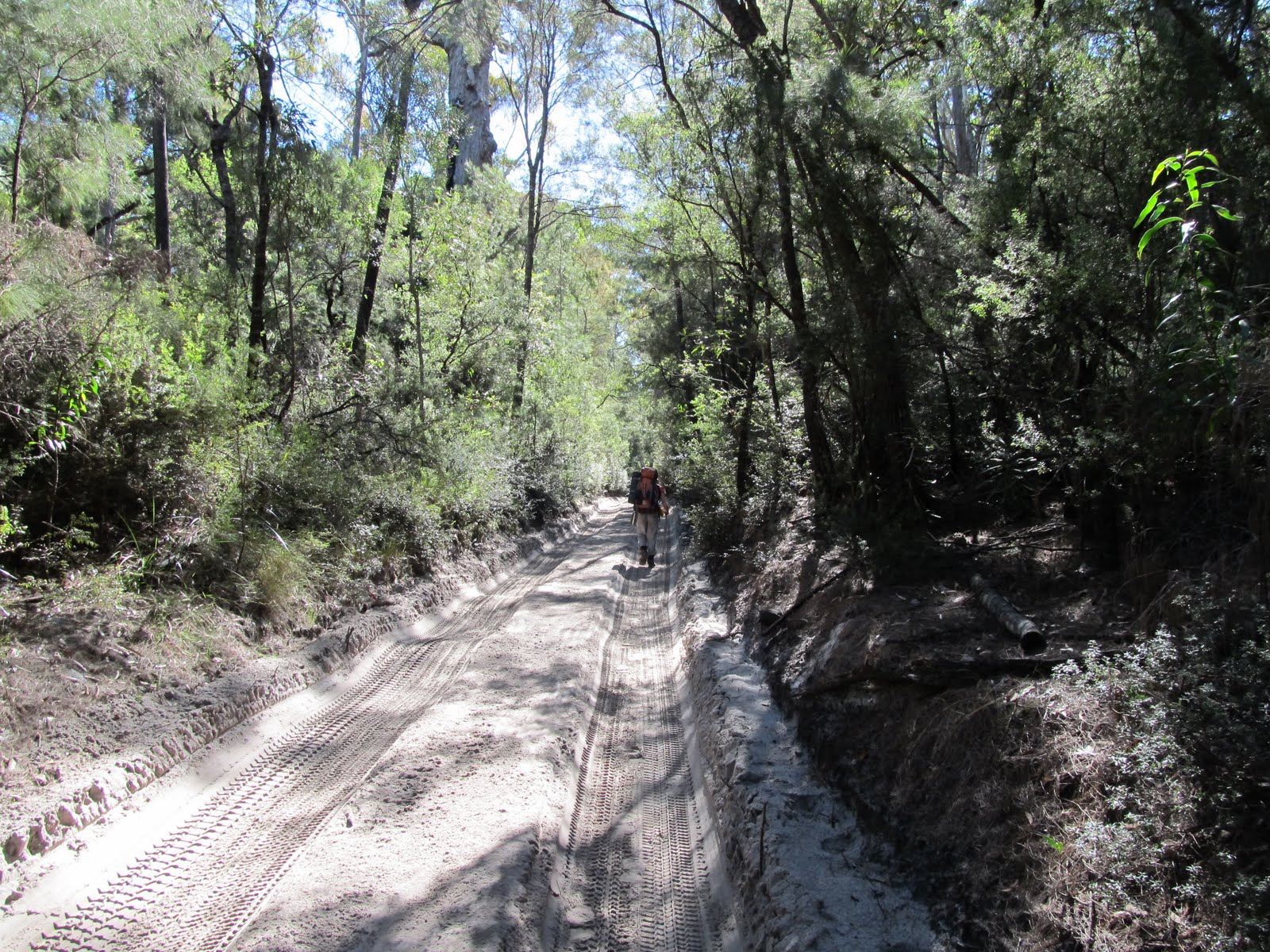 |
| Taking a short-cut via a vehicle track near Lake MacKenzie |
The longest section of the day’s walk was from where the vehicle track rejoined the walking trail to MacKenzie’s Jetty. It was hotter than previous days too, as the vegetation was shorter and we had more direct sunlight on us. However, the packs were lighter, we were fitter, and we had become accustomed to walking, so it was a pleasant hike. Also, the gradient of the trail was gentle as it followed old tramways used in the old days for logging. This all added up to us making better time than expected, so that we arrived at MacKenzie’s Jetty soon after midday.
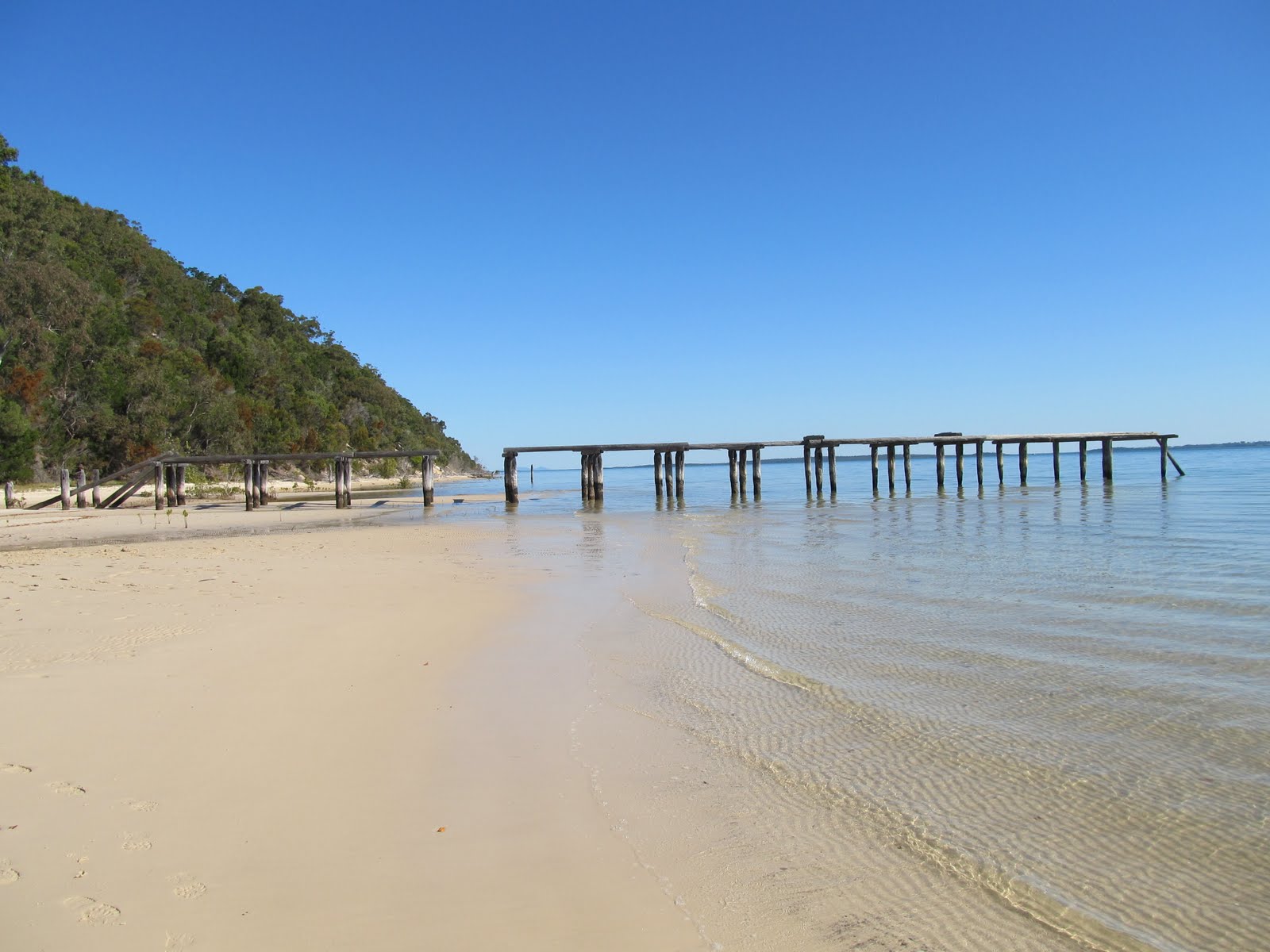 |
| MacKenzie’s Jetty |
At this point, we had a choice about which way to go. The beach route was shorter, but involved walking through sand, while the longer forest trail was firmly packed but quite a bit longer. After testing a bit of the beach walk and finding the sand firm near the water’s edge, we chose the beach route and set off on the last leg of the hike. The sand was soft and hard to walk on in only a few places, so it was a good choice. When we were in sight of the jetty at Kingfisher Bay, we has a ceremony to say farewell to our hiking sticks which had helped us with 5 days of hiking.
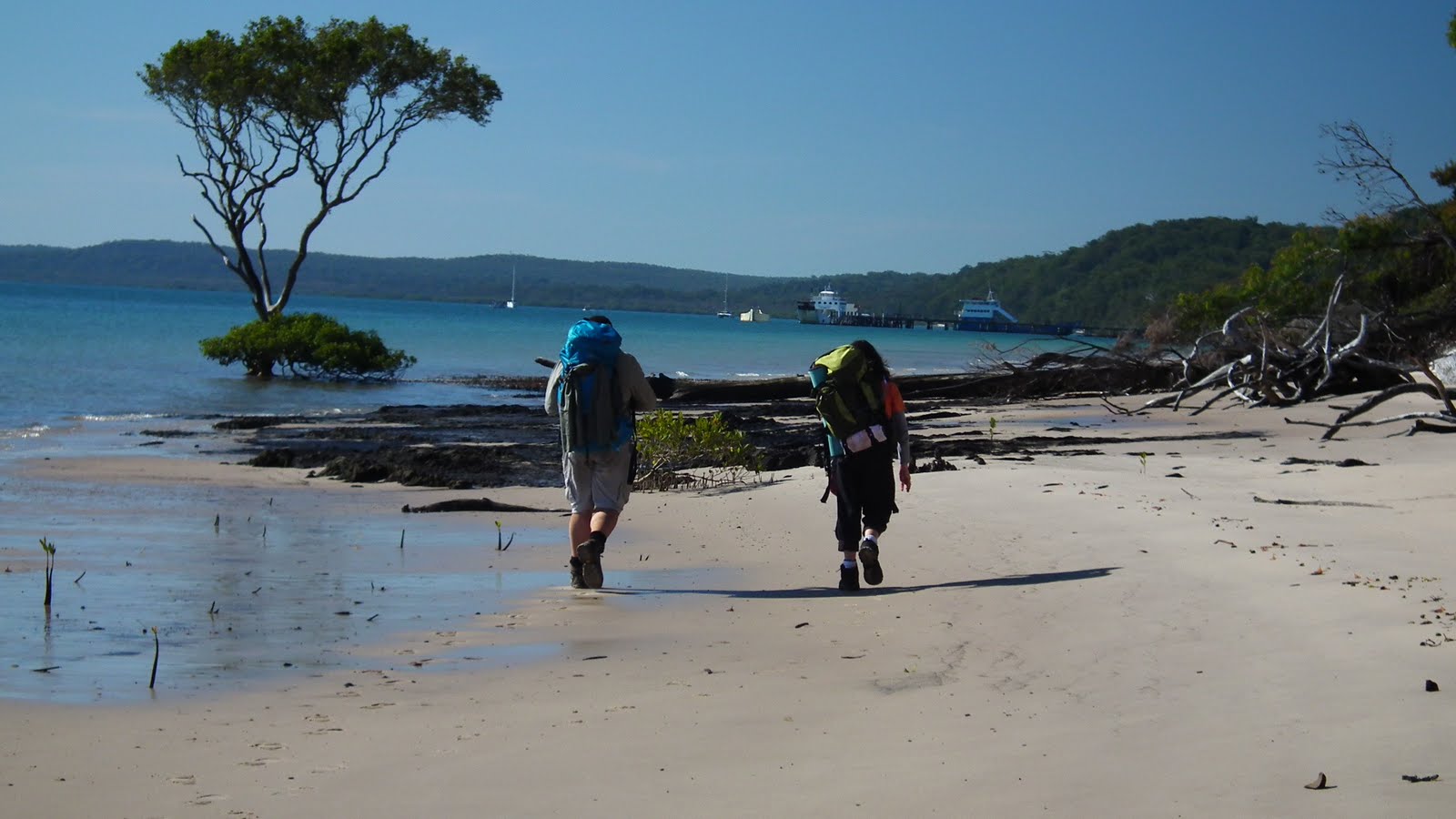 |
| Trekking the final leg to the ferry at Kingfisher Bay |
Hiking of Fraser Island – Day 4
Day 4
Day 4 of the 5-day hike dawned fine and clear at Lake Wabby Walkers’ Camp. After breakfast of hot oatmeal porridge, we packed up the camp and stashed the packs in a dingo-proof steel box. Then it was a short, easy backtrack to the Lake Wabby lookout to view the battle between the lake and the sandblow.
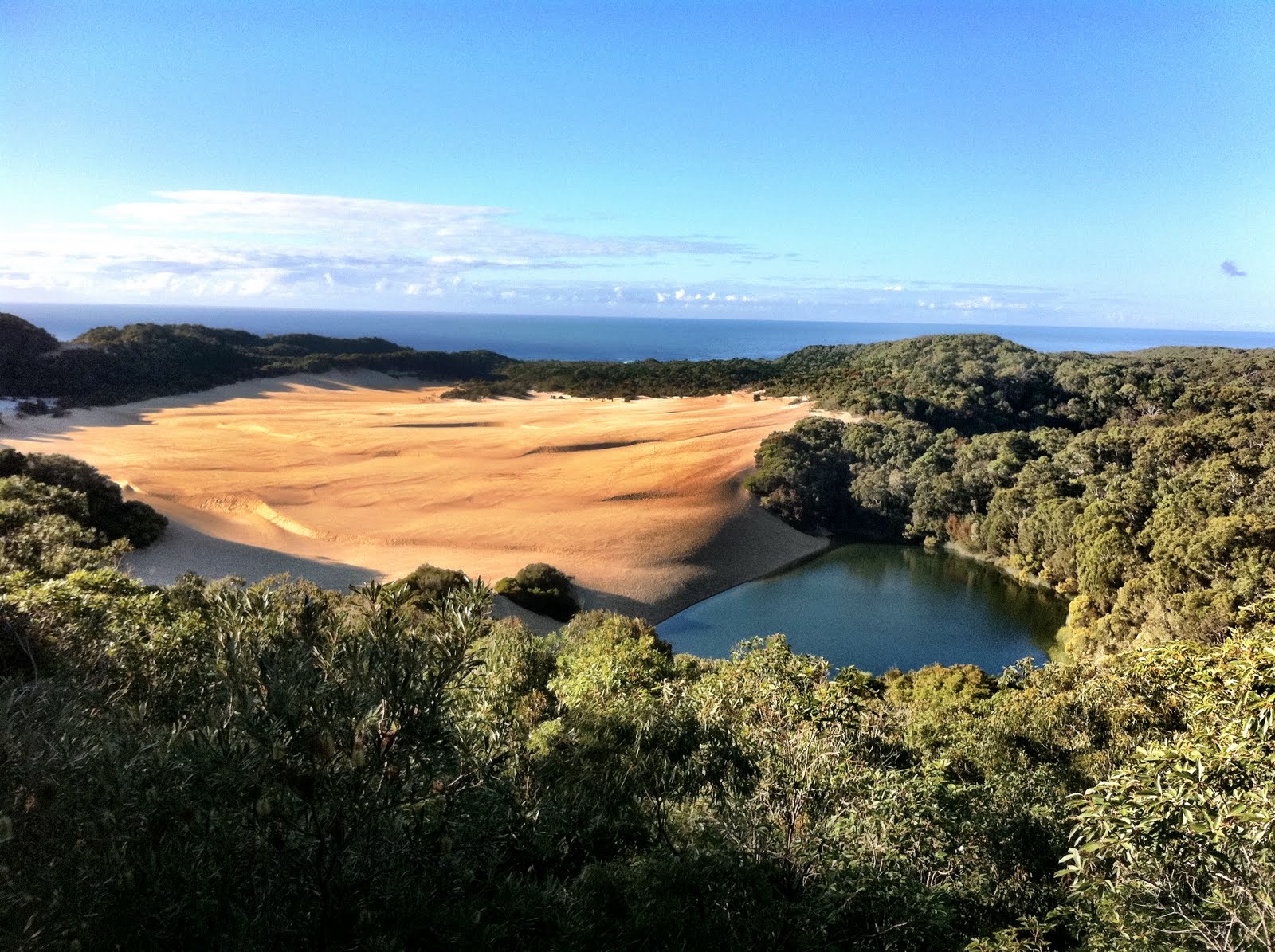 |
| Lake Wabby from the lookout |
Only time will tell whether the lake or the sand dune will win in the end. Perhaps the sand will fill the lake, or perhaps the forest will cover the dune and stabilise it before that happens. In the meantime, we get to enjoy the interaction between sand, water and forest. From the lookout it was a further 1km walk to get to the lake, but we decided not to do the extra this time. We had already been to the lake during our previous trip in 2008, and there were still a lot of kilometres to walk before camp.
From Lake Wabby Walkers’ Camp, we followed an old logging road through valleys of huge trees and over ridges towards Pile Valley. Pile Valley was so named as it was the site of logging for many of the tall straight timber piles used to repair the docks in London after the First World War. Walking through this area now almost a century after logging ceased, it is breathtaking to see the towering trees. We can only imagine what it looked like before logging, with fully grown trees several centuries old!
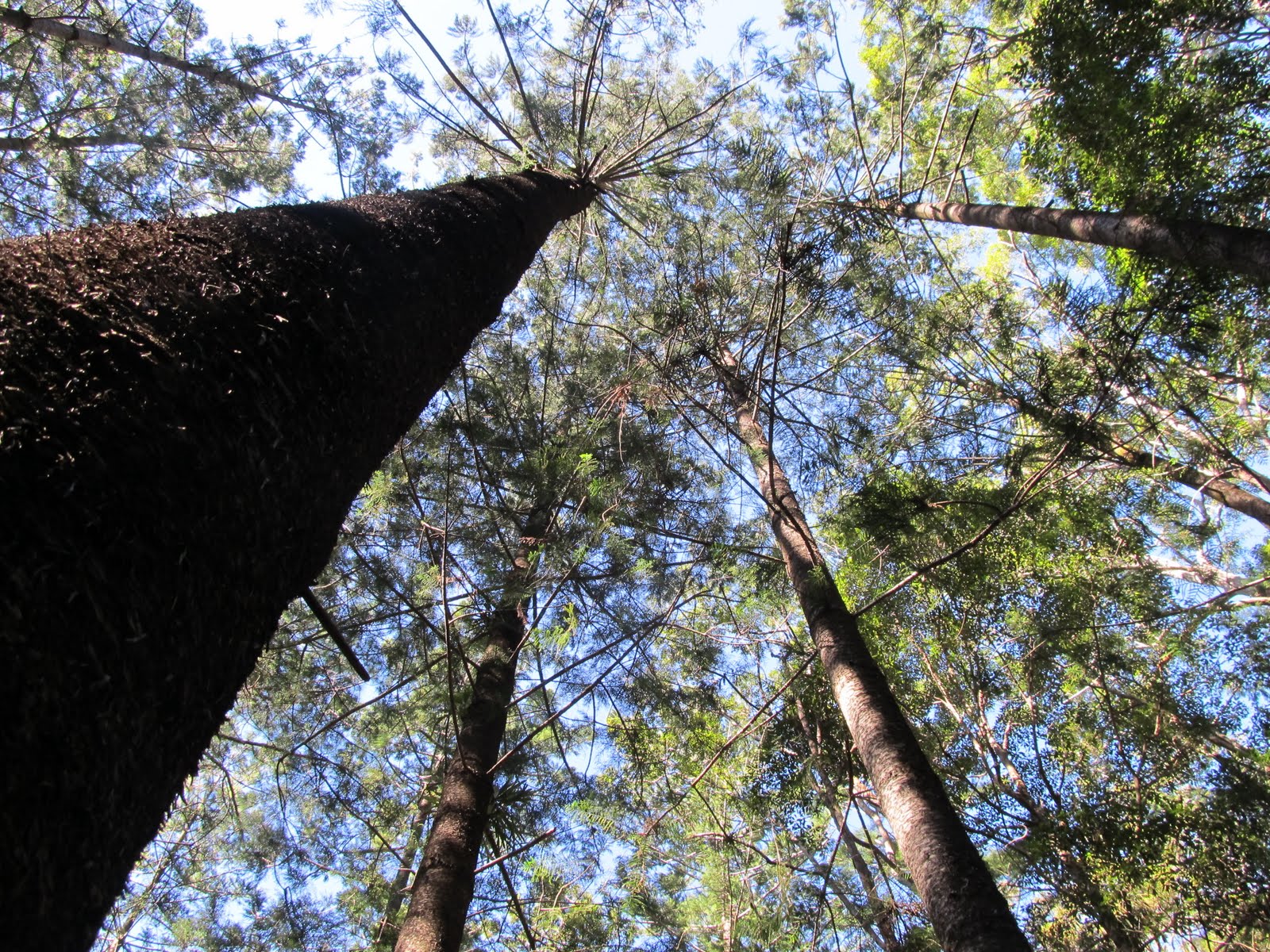 |
| Trees in Pile Valley |
We arrived at Central Station Hikers’ Camp well before sunset. This was partly because most of the day’s walk had been on old logging roads and tramways, so the gradients were gentle. The other reason was that we were becoming acclimatised to carrying the packs. There were times during the day 4 hike that I forgot I had my pack on. Laura and Claire made the same observation, so we thought we were finally getting used to carrying the weight, and packing the gear so that the packs were well balanced.
At Central Station, we were finally able to have hot showers. The only problem was that we had not packed any $1 coins, and they were required to get hot water. Cold showers were not very appealing, but some campers in the main campground were able to change a $5 note for us. There is something very satisfying about soaking away 4 days of sweat and dirt, and we made the most of the hot water. While I was in the shower, I noticed blood running down the shower drain. On investigation, I found a very round, obviously well-fed leech crawling away across the floor. A trickle of blood flowed from my ankle where it was obvious the critter had been feasting for some time before the hot shower made it time to abandon dinner. I was amazed that I had not felt a thing, and even when I found the bleeding bite, I still felt no discomfort. Whatever the anaesthetic in the leech’s saliva, it’s pretty good stuff!
Our final dinner on the island was similar the the three previous ones. Rice flavoured with bacon stock cubes and dehydrated soup mix might not sound exciting, but when you have to carry all your food for 5 days you get to enjoy simple tastes that don’t weigh much. Having to carry a gas stove added some extra weight, but I was very impressed with the gas canisters. I’d packed 2 as I was worried we would run out of gas, but as it turned out, we only used one, and even that had some left after 5 days. All cooking was done in a stainless steel billy – this weighed a bit more than an aluminium one, but it was far more robust. Each of us carried our own bowl, lightweight cutlery set, and mug, and this was all we needed for eating.
Day 5 was to be the longest walk of the trip, so we turned in early at Central Station. No fires allowed, so nothing to keep us up after the sun set anyway.
Hiking on Fraser Island – Day 3
Day 3.
We awoke early on day 3 because it was time to get ourselves organised enough to set up camp in daylight. This meant we needed to break camp in the morning, have breakfast, and set off by 0800. The motivator was an ooportunity to detour 6.5km from our trail to see the largest tree on Fraser Island, a giant satinay tree. An extra 13km hiking might not sound like a great idea, but it was without our packs. The detour took us 45 minutes out and 50 minutes back, and without the weight of our backpacks, it felt like we were floating down the trail! The giant satinay was not as big around as the giant tallow-wood, but it was taller – a majestic specimen.
 |
| Giant satinay tree in the Valley of the Giants |
From the giant satinay, we retraced our steps back to the Great Walk and donned the packs again. Then it was off towards Lake Wabby. Each day, we stopped three times during the hike. Morning tea was after the first 2 hours, at which we ate some muesli bars or dried fruit. Lunch was taken at the halfway point of the day’s hike, so usually occurred about 1230 or 1300. We tried to vary lunch a bit, and on day 3 we had mountain bread rollups filled with salmon and mild sweet chilli. Fresh fruit and vegetables were non-starters due to the weight and lack of refrigeration, but this was OK for a week. Afternoon tea was a welcome halt about 2 hours before we expected to arrive at camp, and consisted of boiled sweets. By this time of the day, we needed the energy boost of a sugar hit, backed up by a trail bar or muesli bar where possible.
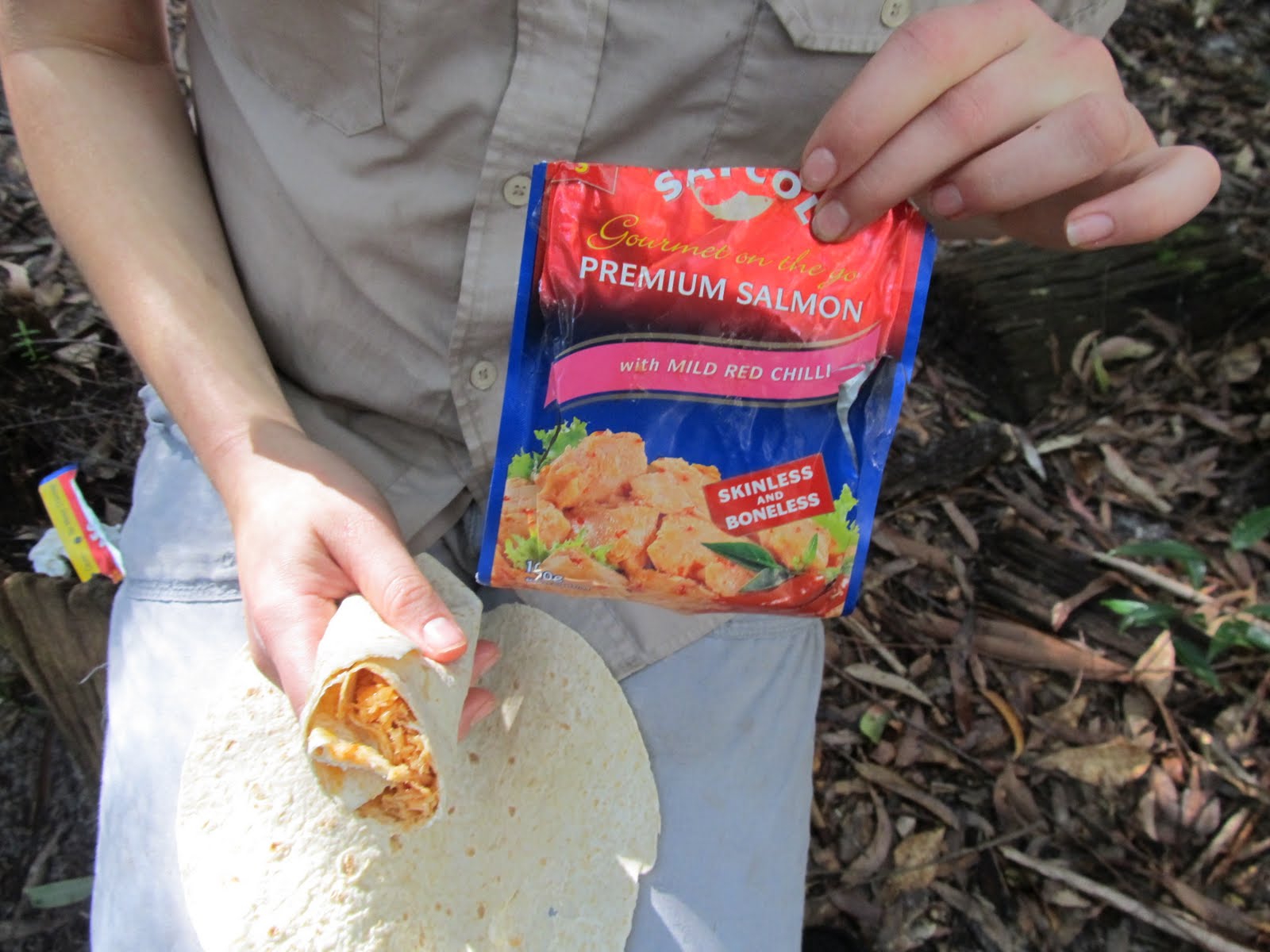 |
| Gourmet lunch on the trail |
One highlight of the day 3 hike was a short detour to see the Bidjana Sandblow. This was a desolate windswept sand dune which was advancing gradually into the rainforest, blowing from east to west under the influence of prevailing winds. It looks destructive, as the sand kills the forest, but it is the mechanism by which the island grows. A mountain of sand builds up and up as it advances across the island until eventually the forest reclaims the bare ground behind it. This reduces the effects of the wind and the sand mountain gradually comes to a halt and is finally completely covered with vegetation. Bidjana Sandblow was only a small example of the phenomenon, but being able to walk up to the leading edge of the dune then climb it, we were able to really appreciate the forces of nature involved.
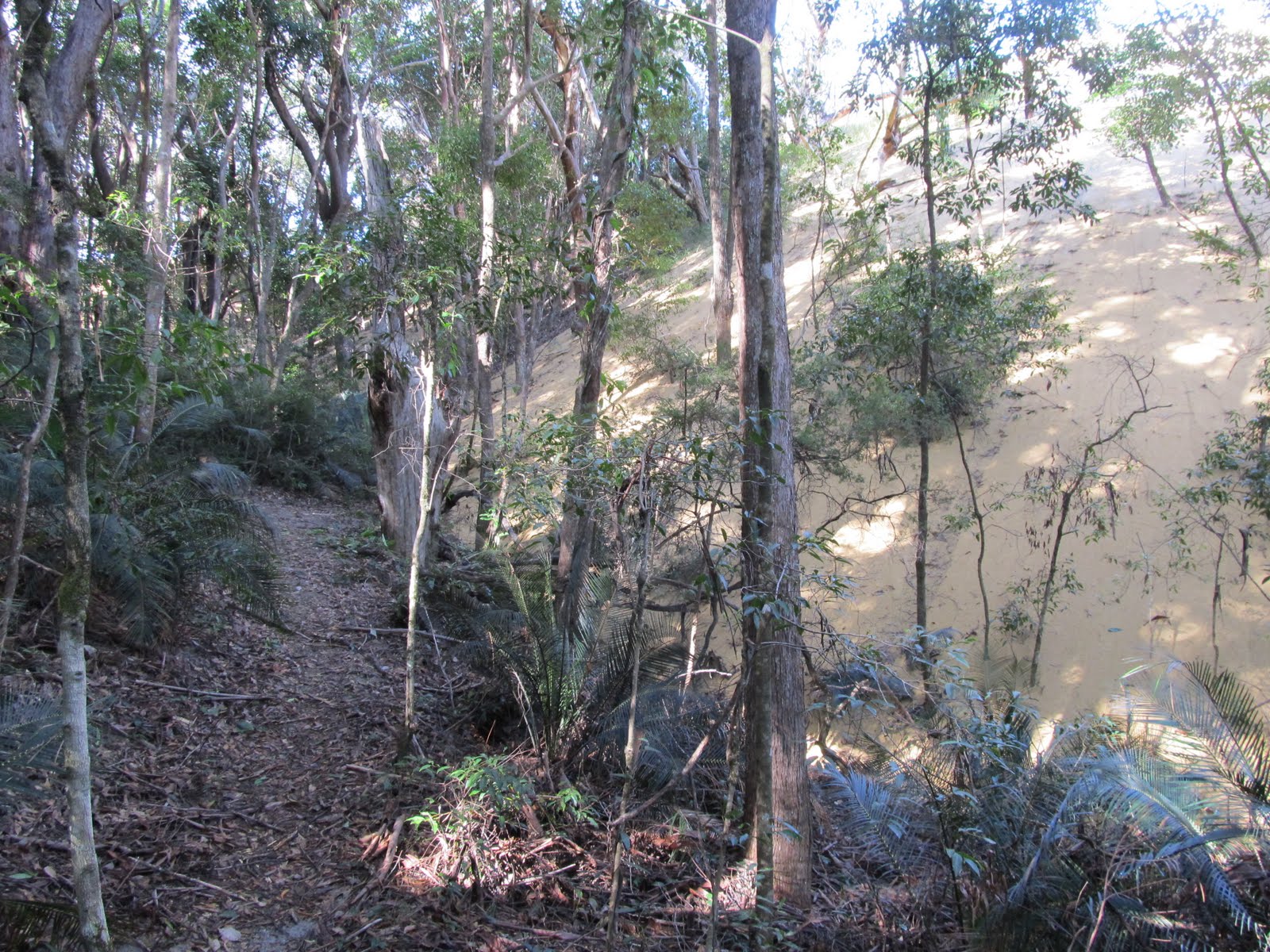 |
| Bidjana Sandblow advancing into the rainforest |
Whle Laura and I were exploring the Bidjana Sandblow, Claire rested with the packs at the turnoff from the Great Walk. During the rest, she discovered a number of leeches on her legs. The bites were painless and bled freely due to the leeches’ saliva. Leech spit contains chemicals that act as an anaesthetic and an anticoagulant. The anaesthetic means that the host is less likely to dislodge the leech than if the bite was painful or annoying like a sandfly or mosquito. The anticoagulant means that the host’s blood clotting is interrupted allowing the leech to drain its fill of blood before the puncture wound stops bleeding. I only had one leech bite during the 5 days, but I didn’t notice it until I was in the shower at the end of day 4. The leech was fat and round having feasted on my blood for quite some time, perhaps up to 4 hours! We didn’t get any pictures of them attached to us as the moment we found one, there was a powerful instinct to remove it immediately. It was only afterwards that we thought it would have been interesting to get a photo. It seems we have evolved to resist having our blood removed and this took precedence over taking photos.
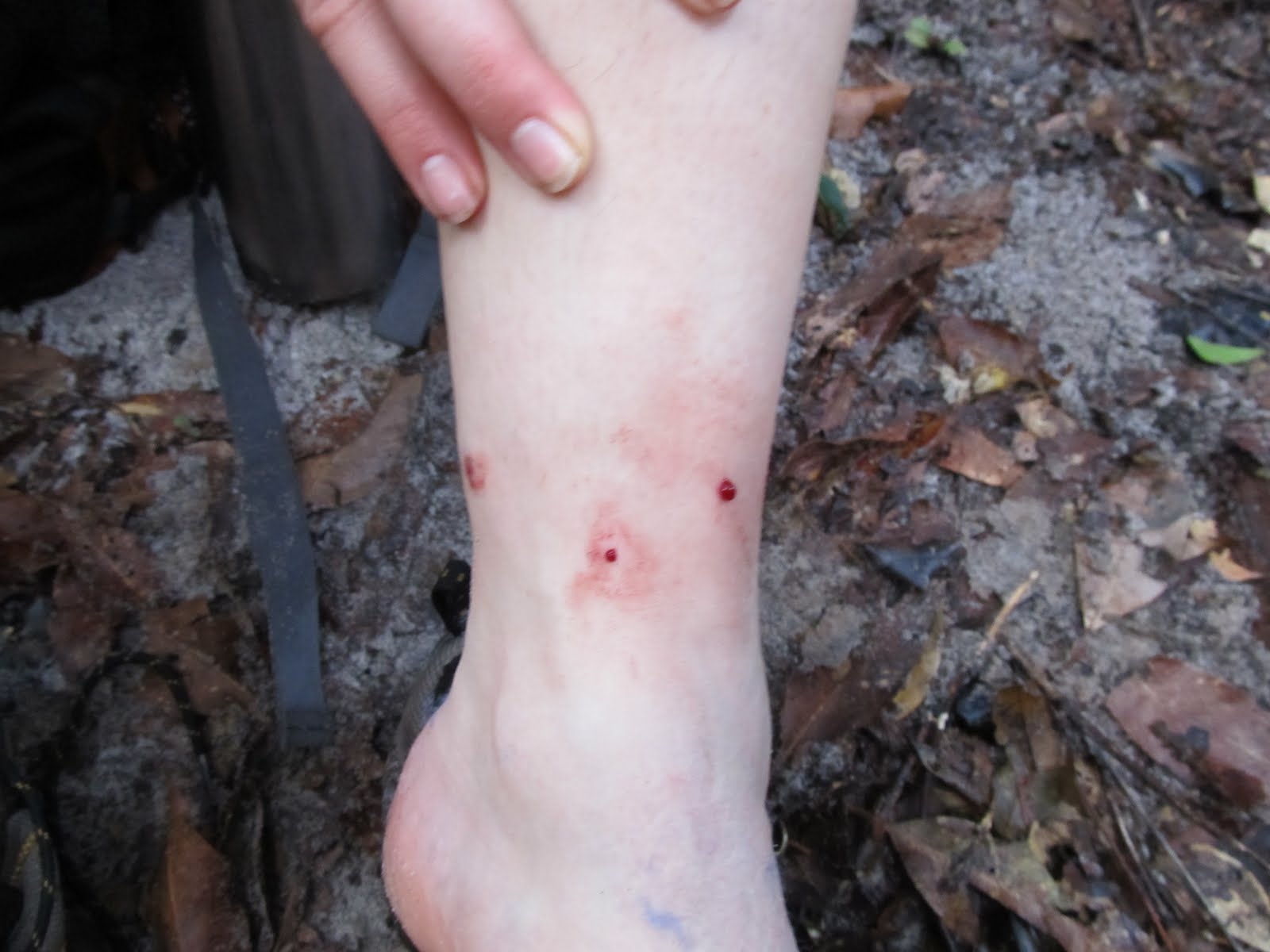 |
| Claire modelling several leech bites |
Our campsite on day 3 was at the Lake Wabby Walkers’ Camp. Finally we had managed to reach camp in daylight, and it was a luxury to set up camp and cook dinner without having to hold a torch. Once again we had the campsite to ourselves. In fact we had yet to see any other walkers on the trail. Apart from a few vehicles seen at checkpoints where the walking trial met vehicle tracks, we had not seen anyone for 3 days. So much for the crowded Great Walk on Fraser Island. Given that I did not have a sleeping mat, and hence was not particularly comfortable, my snoring would have cleared out the campsite anyway.
Hiking on Fraser Island – Day 2
Day 2. We awoke at 0700 to find our campsite wet with rain. It must have been a good sleep, because I never noticed the rain on my hiking tent overnight! Everything except the tent flies kept dry. The food was locked in a steel box to keep it away from dingoes and goannas, and we had our packs under our tent flies.
Breakfast was hot oatmeal porridge made from sachets of flavoured oatmeal. There was water at the campsite, but it was untreated so we used our UV water sanitiser to make it safe to drink. Previously I have used various purification tablets, and they all have one thing in common – they make the water taste revolting!! The UV treatment only takes 90 seconds per litre and does not affect the taste of the water at all. No nauseating chlorine or iodine taste, and no chemical smell. The UV water sanitiser proved to be one of the best bits of hiking equipment we had. Having it meant I was able to go without filling my 4L water bladder, which saved 4kg of weight in my pack.
After breakfast, we hit the trail to hike to the Valley of the Giants Walkers’ Camp. Walking along ridges was fine, as was going downhill, but climbing upwards really gave the leg muscles a workout! We were glad we had left a lot of spare things in the locker at the Roma Street railway station in Brisbane, as every extra kilogram in the packs felt like 10kg after a few hours.
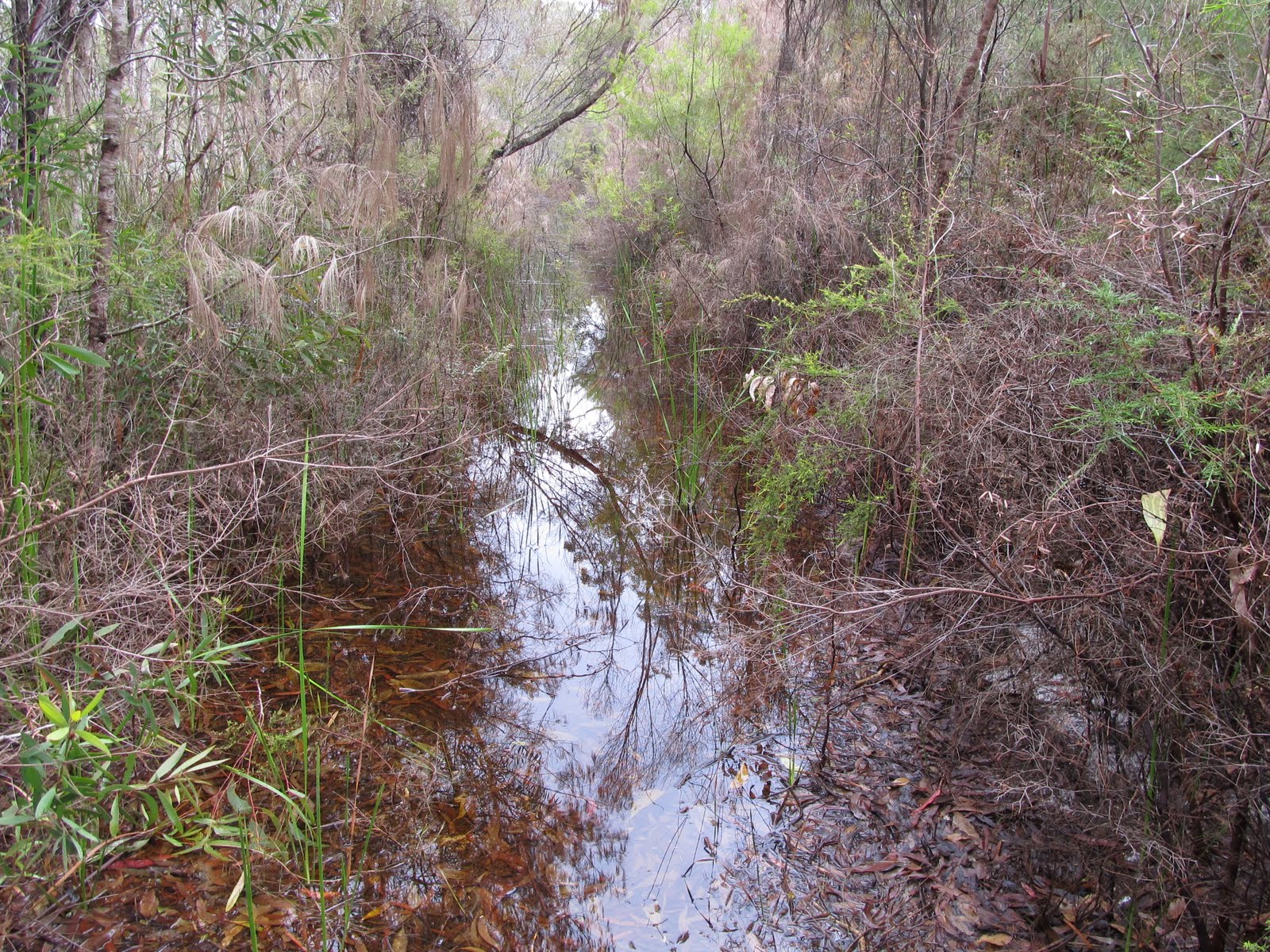 |
| Flooded walking trail between Lake Garawongera and the Valley of the Giants |
An hour or so from Lake Garawongera we came to a swamp, which was flooding the trail. It seems that the big floods in Queensland had also seen the lakes and swamps of Fraser Island filled up to record levels. We had to detour around this, or at least we chose to detour rather than wade through the water. I led the way through thick scrub and got both legs badly scratched for my trouble. Note to self: Always wear long hiking pants rather than shorts! After about half an hour of scrub-bashing, we emerged on the other side of the swamp and back onto the trail. This section is probably why the Lake Garawongera to Valley of the Giants section was supposed to be closed, as there was no clear detour around the flooding.
As we climbed higher into the interior of the island, the trees became bigger and the rainforest more and more spectacular. Some of the trail was situated on an old tramway, which had the advantage of being a gentle gradient and hence easy walking. We were able to relax into the hike and really enjoy the sounds and sights around us. One highlight was a dingo that followed us for several hours. We stopped for morning tea at one point and the dingo came within 10 metres of us, obviously looking for food. Previous visitors have apparently been encouraging the dingos with food so they can get good photos, but this can backfire as it makes the dingoes lose their fear of humans. Then they can become dangerous. We got some great photos of this animal without doing anything to attract it, by using the telephoto zoom lens on Laura’s camera.
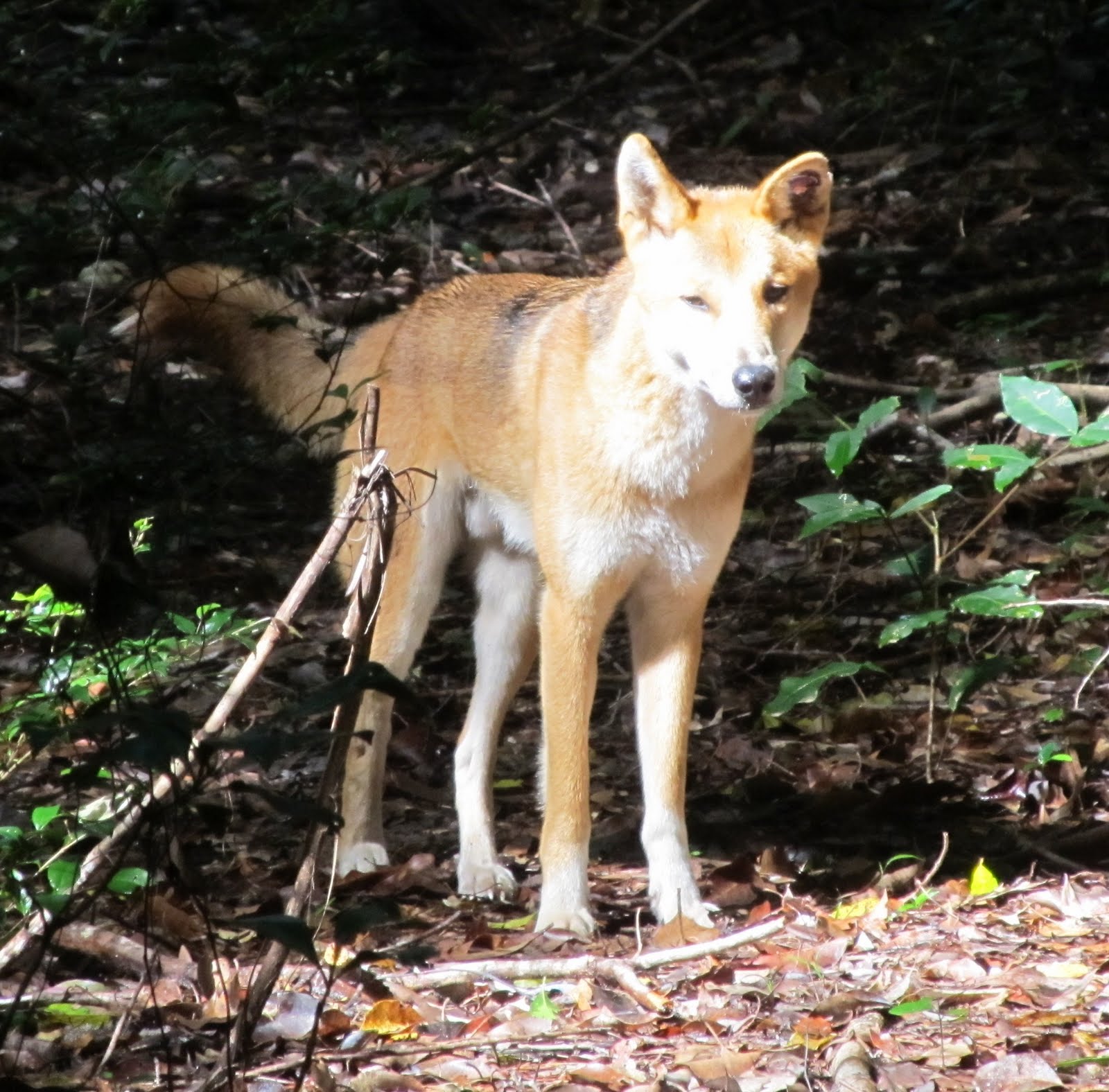 |
| Dingo following us on the trail |
Lunch was at Petrie’s Camp which was a loggers’ camp in the early 1900’s when the area was an important source of timber. Nearly 100 years after logging it was hard to imagine that this thick lush forest was once cut down, except for one thing – none of the trees were really big. The tallow-woods and satinays take up to 1000 years to reach their full size, so all the trees in this area were still junior. Not all of the big trees were logged though. One magnificent specimen in particular remained standing near the end of the day’s hike – before it was hit by lightning and lost the top section, it was the largest tree on the island, estimated to be over 1000 years old. It was getting dark by the time we reached this tree, but we managed some pictures and video of it. A photo of Claire hugging the massive trunk shows the scale.
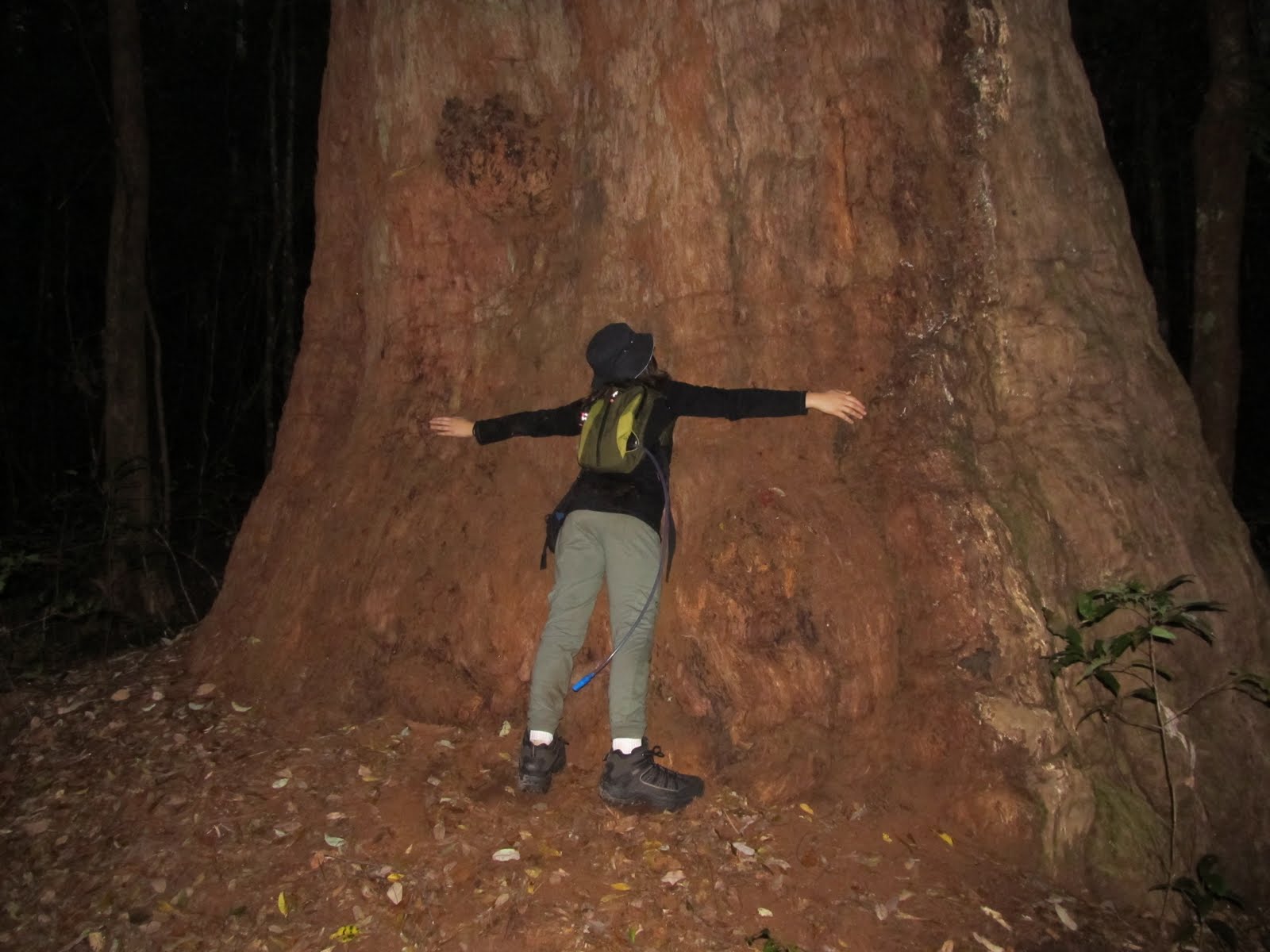 |
| Claire giving the Giant Tallow-wood a hug |
We camped the night at the Valley of the Giants Walkers’ Camp, surrounded by huge trees. Once again we set up camp in the dark, because we started off in the morning too late. Dinner was rice, again, but this time flavoured with chicken soup mix. Rice is a great food for hiking because it is easy to carry and cook, and a small amount is very filling. On other occasions I have existed for days on plain rice, but this trip was the height of luxury with flavours to make the rice more palatable. Cooking was done on a gas cooker powered by disposable gas canisters. Fires were not permitted on Fraser Island, so we had to take gas or liquid fuel for cooking. We chose the gas canister stove because it was light and compact, and used the same canisters at the $20 gas stoves that you get from the hardware shop. These canisters are available practically everywhere, and each one is good for several days.
Hiking on Fraser Island – Day 1
In early July 2011, I spent 5 days hiking on Fraser Island accompanied by two of my three daughters. Laura (15) and Claire (11) donned their backpacks and camping gear for our first major hiking trip together. In April, we hiked two sections of the Larapinta Trail near Alice Springs as a warm-up, but this was our first big hike. Getting to Fraser Island proved a bit of an adventure in itself – see my blog ‘Transport troubles on holiday’ for details. However, once we arrived it was worth the effort, and then some!
Day 1. We arrived on the island at 0945 on the Kingfisher Bay barge, to be picked up by the Fraser Island Taxi as arranged. The taxi took us across the island to Eli Creek, which we has selected as our starting point. The plan was to spend the 5 days hiking back to Kingfisher Bay to catch the barge back to Hervey Bay. On the way in the taxi, we heard a rumour that the northern section of our planned route was closed to walkers due to flooding. As it turned out, the track was flooded in places, but there were no signs advising closure of the walking trail, so we went ahead. Anyway, I’m getting ahead of myself a little.
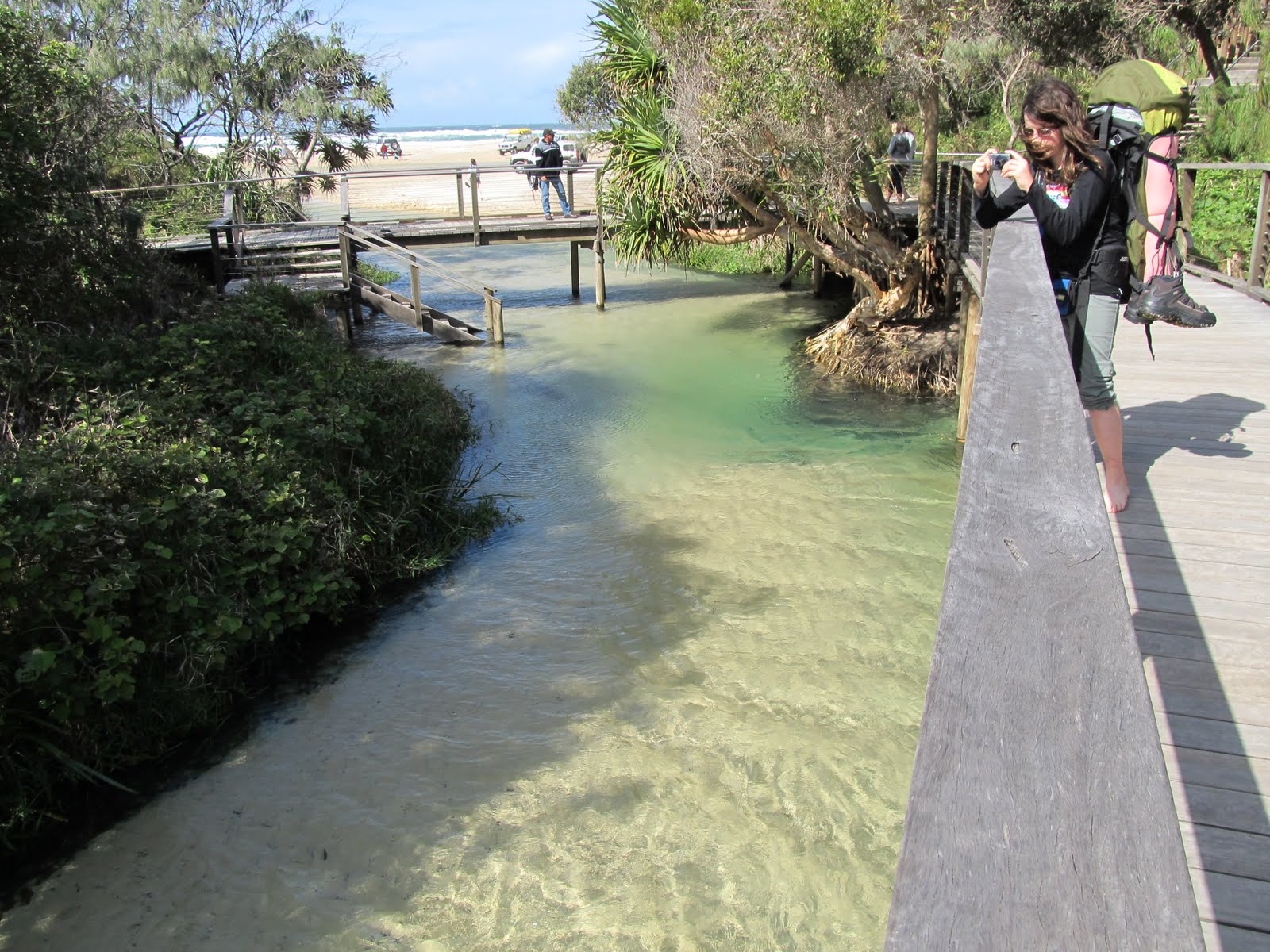 |
| Eli Creek |
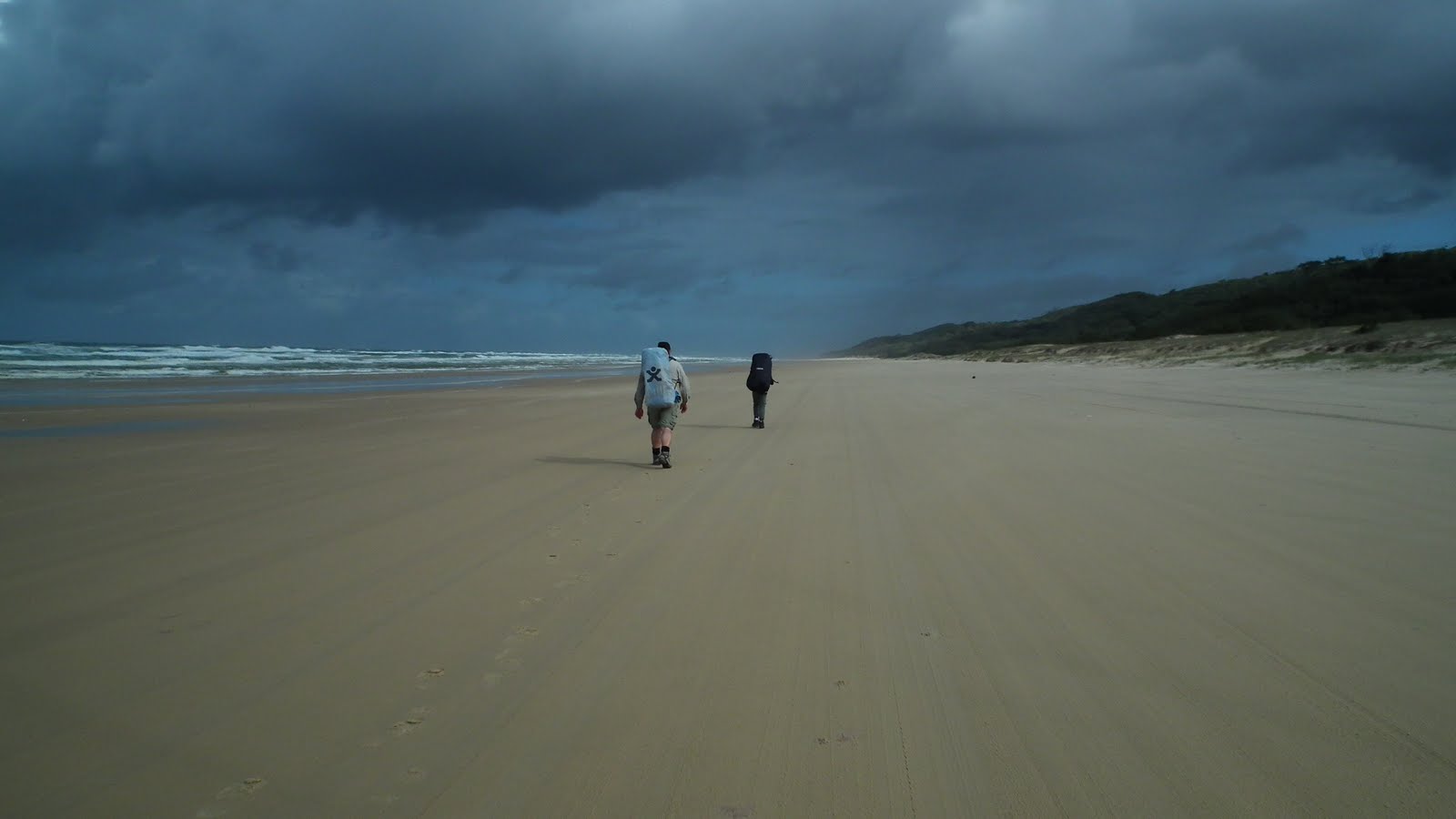 |
| Hiking along the beach towards Happy Valley |
The northern end of the Fraser Island Great Walk is at Happy Valley village, and our starting point was 6km up the beach at Eli Creek. This is a beautiful crystal clear freshwater creek flowing out of the sand dunes and across the beach. Claire had a short swim and said the water was fine, but I thought it a bit chilly so settled for wading in for some photos. We then loaded up and walked along the beach to Happy Valley to start the Great Walk. Just on dark, we arrived at Lake Garawongera, but due to flooding we had difficulty finding the walkers’ camp. Not that it was actually hard to find, but the signs were oriented to the trail that was in the lake, and we deviated around the flooded section so missed the turn-off. After 2 hours with torches heading up the wrong track, we finally found the campsite and set up for the night. Dinner was rice flavoured with peas, vegetable soup mix, and bacon stock cubes. After our troubles getting to the island, and then 8 hours of hiking, we were soon out to it in our sleeping bags. Unfortunately I managed to leave my hiking mat at home, but I found that scooping a small hollow in the sand for my hip enabled me to get comfortable.
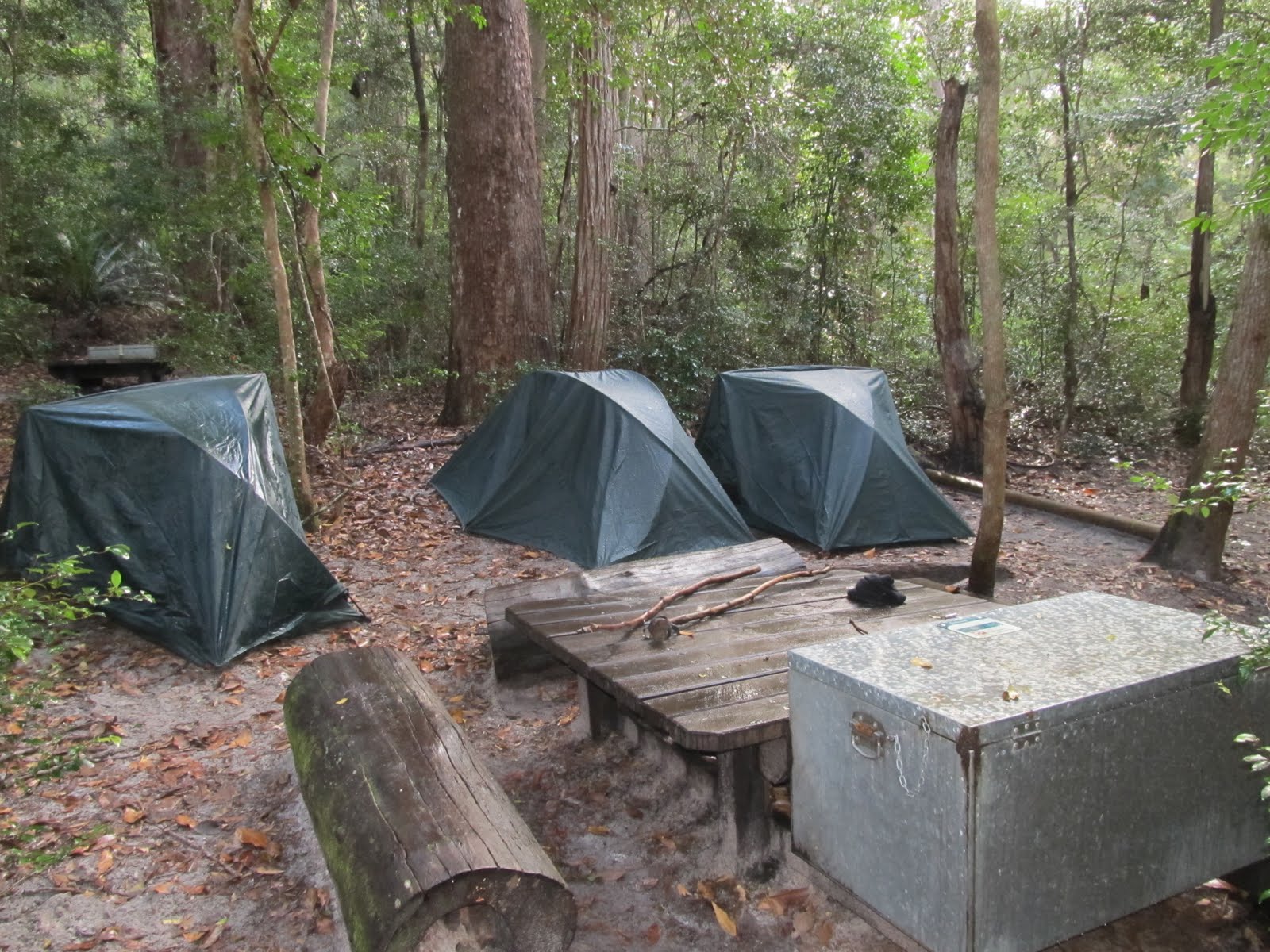 |
| Campsite at Lake Garawongera Walkers’ Camp |
 John's Blog - Rants and Rambles from the NT