Cookbook clinical practice

For many years I have been dismissive of the trend towards what I call “cookbook practice”.  This is clinical practice in which all the decisions are pre-set, and the clinician just fills in the blanks and follows the resulting algorithm for treatment or referral.  My objection was based on the idea that clinical judgement is an expected skill/attribute exhibited by practitioners, and they should not have to be spoon-fed.

Recently, I have begun to have my thinking modified by some new data (well, ‘new’ to me anyway!).  Safety and quality in healthcare has been expensively studied over the years, and it has been found that having clinical guidelines in place significantly reduces the incidence of adverse events.  This may suggest that even good practitioners can benefit from having robust well-founded clinical guidelines to help with decision-making.  I’m still not completely comfortable with the idea, as I worry that guideline-based practice actually reduces the need for clinical judgement.  Maybe clinical guidelines work because practitioners need help making good decisions?  What if we looked at improving their decision-making, and their critical thinking?  Would that not achieve the same or better results?

In some ways, it seems analogous to the issue of young drivers on the roads.  This group are horribly over-represented in road crash statistics, so it seems logical that something needs to be done.  Is it more training and guidance for a longer period of time that is required, or is it more effort into creating drivers who think actively about what they are doing and learn good attitudes and habits?  If having L-plates for 2 years proves to be safer, what about 3 years?  If the restrictions of provisional drivers licences make young drivers safer, what’s wrong with applying those restrictions to all drivers.  After all, if we did not allow anyone to drive until they were 21, the road crash data for 16-20 year olds would improve dramatically!

I think the answer is the have reasonable guidelines, then teach people how to think properly.  Some sort of attitude test if you like.  If you don’t pass, you don’t get a licence until you grow up a bit more.  I know some 16 year olds who are more mature than some 46 year olds, and much safer drivers as a result.  Likewise with clinical practice, I think it should be mandatory to pass some sort of critical thinking test before you are allowed near patients.  How that would look in practice, I’m still thinking about.  Watch this space …
Losing weight

Yesterday I had the dubious pleasure of having an appointment to discuss my blood pressure control.  I spoke with a Registered Nurse, a renal specialist, and a dietician.  It seems that I have reached a plateau in my use of medications, currently at 4 tablets per day.  Now the focus is on shifting the lard from my midriff.  Easier said than done! 

About a year ago, I weighed 112kg and decided I was sick of being unfit and obese.  So I cut out eating bread, not because bread is a bad food, but because I tended to put bad stuff on it.  This was pretty successful, and in 3 months I lost 12kg and kept it off.  Over the next 6 months, I started eating bread again, but less than before and trying to choose healthier fillings.  The weight stayed around 100-102kg, which is where it is today.  The frustrating thing is that it doesn’t seem to matter what I do now, I can’t crack the 100kg barrier!  I even tried the bread thing again, but no luck this time.

Seems like portion control and physical activity is the way ahead.  So now that I have my new bicyle (see previous posts) I’m riding at least 16km daily.  Portion control is hard, but I’m trying an idea of using smaller plates to fool the eyes.  Time will tell if I can smash through the 100kg barrier and head to my goal of 90kg.  I know that if I can start getting the weight off again, then I will be motivated to keep doing whatever it was that made it happen.  Well, I think I know that anyway.  Here’s to seeing what the scales say at the end of June, my next deadline.

Holidays are coming!

I have an app on my iPhone that tells me that we go on holidays in 38 days.  In the Northern Territory we get 4 weeks school holidays in the middle of the year, so this is when our family tries to go on a big trip.

This year the plan is to go to Adelaide, then Brisbane and Fraser Island, back to Adelaide, then off to visit my siblings on Eyre Peninsula before returning home. We have four weeks to fit it all in, so part of the fun starts now with the planning.  There is a long list of people we’d like to catch up with, and we also have to fit in some essential tasks like fitting the new engine into the Landcruiser and getting it tuned correctly.

One of my concerns is security, as recently a Tennant Creek resident returned home from holidays to find his home wrecked and ransacked.  There’s not a great deal you can do, except lock everything up and try to make it look as if you’re still around.  We have insurance, but that wouldn’t make up for losing the things which are dear to us.  Two of our bikes were stolen a few weeks ago, as I have posted about, and that was bad enough.  Anyway, I guess we just have to cope with the concern, otherwise the only solution is to never go anywhere.  If that was the solution, we’d be better off not owning anything!

So the holiday planning is coming along well.  There are so many things to arrange that this year I’m doing something new, I’m using a checklist to make sure I remember everything.  Maybe I’m just getting older, but it does detract a little from my enjoyment of a holiday when I forget something important!

Sleepover

Claire is having her first friend’s sleepover for a long time, maybe 2 years or more.  The girls had fun dancing to the Wii, playing various console games, making a campfire in the backyard, making soup over the fire, playing hide-and-seek, eating home-made pizza, and generally having a lot of fun. Now at 1:40 am they are having their showers and getting ready for bed.  Might be a sleep-in in the morning!

Rational thinking

For a long time, I have highly valued rational thinking.  At school I was strongly attracted to the rational disciplines – mathematics, science, chemistry, biology, physics and so on.  Conversely, I was repelled by the fuzziness and subjectivity of humanities and the arts, in which the same piece of work can get different (sometimes vastly different) marks from different teachers.
When I dabbled in religion for a while, mostly to try to find some sense of belonging, I was likewise repelled by the almost total lack of logic and rational thinking.  Despite vehement assurances to the contrary, I finally realised that to accept religion I would have to reject rational thinking, so I did the only same thing I could do, I rejected religion.
Somewhere along the way, I was misled by a very common myth about rational thinking.  I assumed that there was such a thing as an autonomous rational mind, and this meant that two people applying rational thought to the same data set would arrive at the same rational conclusion.  After all, is that not true of the pure sciences such as mathematics – there is one right answer and a million wrong ones?  Well, yes and no.  While there may well be only one right answer in an absolute sense, in the real world there may be more than one rational answer.  Let’s use the example of my wife choosing a dress to wear to a formal event.  It is likely that in her wardrobe, she has only one dress that really meets the criteria for the event, but if she doesn’t like it, the rational choice is for me to agree with her wearing what objectively is ‘second best’.  That is not because everything is relative, as I reject that premise, but because priorities and external factors do affect rational decision-making.  If someone holds a gun to your head and demands that you agree that two plus two equals five, is it rational to disagree with him?
So I guess the point is that I grappling with the implications of rational thought being inevitably coloured by subjectivity.  Firstly, I will have to be more accepting of people whose conclusions do not agree with mine about a particular situation.  Secondly, I will need to seek more external validation of my conclusions, so that I can benefit more from the wisdom of others, rather than relying on my own rational thinking.  Finally, I will need to spend more time examining my assumptions and biases, looking more deeply than I have previously to find the real reasons for accepting one idea over another.
And for the hot potato question – have I changed my mind about religion?  Absolutely not.  My problem is not that religion uses a different rational thinking than I do, it is that it is not rational at all.

Leadership

To pass the time on night shift, I was having a discussion with a colleague about various things affecting the nursing profession.  We covered a lot of things, and one of them was leadership.  It is sometimes (or often?) said that nursing suffers from a lack of leadership.  What does that mean?  What is leadership anyway?

In 2009-2010 I had the great privilege of participating in Course 16 of the Australian Rural Leadership Program, so I may have some answers. Or not.

Leadership is about moving forward, taking a group of people towards a shared goal.  It involves inspiration, encouragement, and negotiation.  It requires integrity and commitment, and a healthy dose of self-awareness and self-criticism for the leader.  An effective leader is one who is able to see both the day-to-day realities that impact on outcomes, but also the big picture that shows what it’s all about and where we are heading.  He or she needs to be able to communicate the vision, and inspire other people to strive towards achieving it.

If this sounds like a tall order, that’s good.  It is a tall order, and the reality is that if we settle for anything less from our leaders, we are shortchanging ourselves.  Leadership is not meant to be easy, although there are some very inspirational leaders who make it look easy.  Don’t be fooled by appearances – it is very likely that these people work extremely hard behind the scenes to make things work up front.

So does nursing lack leadership?  I guess that depends on what standards you set, and which branch of the nursing tree you focus on.  The whole organism has some excellent leaders, such as the Commonwealth Chief Nurse (Rosemary Bryant), but the same cannot be said for all of the specialties.  For example, remote health relies on a few dedicated individuals to raise the standards and push for meaningful reform, but the general tone is one of mediocrity and pettiness.  The peak professional body CRANAplus can and does provide some of the leadership required at the big-picture level, but what is often sorely lacking is grass-roots leaders.  People are needed who are willing to step up to the plate and make their own practice exemplary, then accept the challenge to be role models to their peers.  ‘Tall poppy syndrome’ is very real, but leaders have to rise above such petty jealousies and show the way to improve the world around them.  After all, if you can’t make a difference by being a good leader, or by following one, what’s the point?

Basics card – some thoughts

I don't know if this would work, or have consequences I haven't thought of, but I think all social security money should be via the Basics Card. I don’t mean pensions and the like, but income support type payments like unemployment benefits and student payments. As a socialist society, we have a responsibility to support the less fortunate, and I accept the cost of doing so. However I strongly object to supporting a welfare lifestyle, in which people are able to live a life of indolence at my expense. The fact that people below the poverty line can afford to buy alcohol and tobacco, and other drugs, galls me. Especially when my tax dollars are funding this expenditure.
I read recently that the tobacco excise in the NT was to be increased by 25% and some tosser commented on the media that this would amount to child abuse as people would not be able to feed their children as a result. You’ve got to be kidding!!! What happened to parental responsibility and the need to set priorities? Maybe I should claim that I can’t feed my children because I need the money to buy a new computer or upgrade my iPhone!!
The Basics Card can be used to purchase all of the necessities of life so 100% of welfare income should be managed in this way. If people want cash they need to get a job. Sure they won’t be able to buy grog or smokes or take a holiday, but so what. Why should the state pay for luxuries anyway?

A bit of concrete

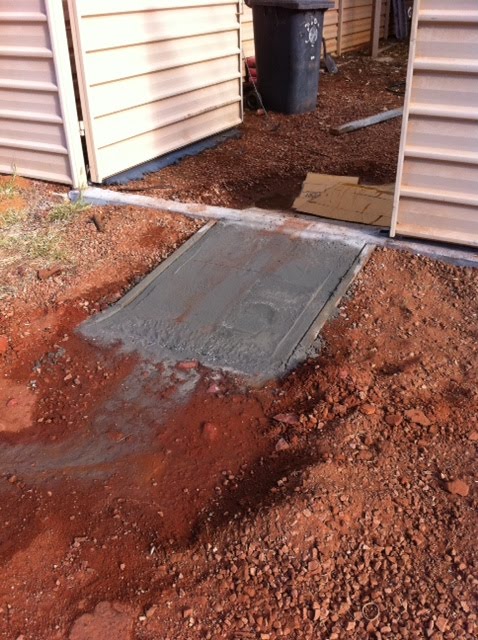
Today’s project was to improve the accessibility of our yard for Anita’s electric wheelchair.  A few weeks ago, I concreted a slab across under the gates to stop the dogs wriggling under the gates and getting onto the street.  This made it impossible for Anita to get out with her chair unless I was around to assist, so I made a couple of ramps.  Unfortunately, they were too short and steep due to not having enough concrete left over.  So today I had the extra concrete premix to complete the job.
The idea is to reduce the angle so that the wheelchair can safely cross the gateway.  As the chair reaches the top of the up ramp, it acts a bit like a bulldozer as it tips onto the down ramp.  This is because of the type of chair it is (see the picture)
The angle of the two ramps meeting at the top of the beam under the gate needs to be gentle enough so Anita doesn’t get thrown out of her chair as she goes over the crest.  I think I have it now, with each ramp being a metre long to traverse a step 100mm high.  By making the ramps long enough, Anita will now be able to inch her way over, where before with the shorter ramps she had to keep up her momentum.  She said it was just a bit too exciting before as she had to hang on for dear life as the chair lurched over the summit and tried to launch her into the gravel.
If it was our own house, we’d concrete or pave the whole driveway and be done with it.  However, spending that sort of money on a rented house is silly, and while the landlord makes noises about paving the driveway, we’ll be long gone before it happens!
Inside the house is pretty wheelchair friendly.  It’s just getting into the yard, and then the house that’s a bit tricky.  However, with the right ramps in strategic locations, we should be able to manage OK.

Old or new?

There have been times that I have wondered if it is better to buy a new 4WD rather than fix up the old one.  These times usually coincide with being covered with oil and grease, skinning my knuckles and swearing underneath the old one.  Fortunately, or not as the case may be, I usually feel OK about it all by the time I crawl out from under the vehicle and enjoy the thrill of having done the job myself.  So I’ve never seriously looked at getting a new 4WD.  
But what if I was serious about it?  Well, the first obstacle is the mirth of the lenders when I front up with a request for $40-80K.  Then there is my horror at the repayments if they actually agreed to my request.  It would cost more each month than my mortgage, and all for a depreciating liability that will drop steadily in value as it sucks my bank account dry.  On the plus side, and it’s a pretty big plus after 40 years of working on engines (yes I stripped down my first engine at the age of six to work out how it ran, and yes again, it still ran when I reassembled it!) I wouldn’t have to work on it to keep it going.  At least I hope I wouldn’t have to work on it because I wouldn’t be able to.
My current vehicle is in the process of getting a heart transplant, which will end up costing me about $5000.  The  bonus to sweeten the deal is that the transplanted engine has a turbocharger on it.  To fit a turbo kit on my existing engine would cost me around $2500 plus tuning plus pump calibration and probably overhaul, plus the engine rebuild needed before the kit went on.  All that would leave little if any change out of $10,000, so the transplant is economical.  However, there’s no way around the fact that I will still have an old-technology engine, with old-technology fuel consumption to match.  While more modern large 4WDs boast fuel consumption of 10-12L/100km with their common-rail diesel engines, I typically count on 17-18L/100km.  The newer engine with a turbo may hopefully do better, say around 14L/100km, but still well short of the what the new technology can achieve.
What it comes down to in the end is the cost of making the change.  A new vehicle may be cheaper to run regarding fuel, but will cost a lot more in servicing and repayments.  My old 4WD is debt-free, so I can drive it for tens of thousands of kilometres for the price of a new vehicle.  So that’s the answer for me – the old 4WD stays, and gets some well-earned TLC with the money I save by not buying a new one.  Not to mention going on some more awesome trips!!